JnK Plugins
Interlinks Manager Alternatives for WordPress (2026): What to Use Instead
If you searched for an Interlinks Manager alternative, the first thing to know is that DAEXT, the company behind it, has already picked one for you. On its wordpress.org listing DAEXT now says Interlinks Manager “has been superseded by Link Manager, a broader plugin for managing links in WordPress”, and that Interlinks Manager will get maintenance updates until 8 July 2027, after which it will be removed from the directory. The old product page on daext.com now redirects to Link Manager. (All checked 16 September 2026.)
So the real question has changed. It isn’t “what replaces Interlinks Manager” in the abstract any more; it’s whether you move to DAEXT’s successor or use the deadline as a reason to look around. This post covers both, with the trade-offs, and it gives the original fair credit, because its link-equity reporting is still unusual.
How we compared: the plugins with a free build were installed and run in July 2026 on a WordPress 7.0 / PHP 8.4 test site with about 50 posts: Link Whisper Free 0.9.6, Internal Link Juicer 2.26.0 and our own JnK Linkweave (then 1.3.0; it is at 1.6.0 now). Link Manager Pro and Yoast SEO Premium are paid, and we did not buy them for this post, so those sections come from the vendors’ own pricing pages, feature tables and FAQs. Every price and plan detail below was re-checked on the vendor’s site on 16 September 2026.
What Interlinks Manager did well, and what happens to it now
Interlinks Manager earned its place by taking reporting seriously before most linking plugins did:
- Link-equity estimates. A per-post score for how internal linking value is distributed, so you can see which pages hoard it. Very few tools try this.
- Automatic links from keyword rules, with limits per article and per URL.
- Link statistics per post, and later a broken-links status screen in the free build.
The catch is the timeline. After 8 July 2027 it leaves the wordpress.org directory, so you won’t get compatibility or security fixes after that. If it works for you today there’s no emergency, but it is a plugin with an end date, and it’s worth deciding before that date rather than after it.
1. Link Manager: the successor from the same developer
Best for: anyone happy with Interlinks Manager who just wants the supported version.
DAEXT describes Link Manager as including “all the features of Interlinks Manager, along with additional capabilities”. Its own Lite-vs-Pro table splits it like this. The free version keeps the familiar parts: per-post link stats, inbound link counts, the link-equity calculator, and keyword-based automatic links with post type, category and tag targeting. Pro adds internal link suggestions in the editor sidebar (scored on title overlap, shared categories, tags and post type), broken-link detection, click tracking, the overview and domain reports, CSV exports, bulk tools and user permissions.
Pricing: Pro is $59 a year for one site, $99 for five and $149 for twenty-five, sold through Paddle, with a 30-day refund policy. DAEXT’s FAQ also says the plugin “will continue working when your license expires”, you just stop getting updates.
Two honest notes. Broken-link detection, which the old free Interlinks Manager build had, is a Pro feature in Link Manager. And the editor suggestions are rule-based (titles, categories, tags) rather than reading the article text, so they work best on sites with tidy taxonomies.
2. Link Whisper: the most polished paid workflow
Best for: people who want the smoothest suggestion workflow and don’t mind a yearly subscription.
Link Whisper is the best-known dedicated linking plugin, and the day-to-day experience shows it. It suggests links while you write and inserts the ones you tick. Its features page lists four reports (links, domains, broken links and link clicks), auto-linking that starts in a review mode, a URL changer, a related-posts widget and a visual site map, and it works in Gutenberg, the Classic editor and Elementor.
Against Interlinks Manager you gain a nicer suggestion workflow, AI-assisted suggestions and click reporting. You lose the link-equity model, because Link Whisper counts links rather than estimating how value flows. Pricing: $97 a year for one site, $197 for three, $297 for ten and $497 for fifty, each with an AI-credit allowance (2,000 to 10,000). The money-back guarantee is 14 days for new customers, and there’s no lifetime option. We go deeper in our Link Whisper comparison.
3. JnK Linkweave: the free-first option
Best for: keyword rules and site-health reports without a yearly bill, and click analytics if you pay.
Disclosure: JnK Linkweave is our plugin. Weigh this section accordingly; everything in it can be checked against the free download.
The free version covers the part most Interlinks Manager users rely on: unlimited keyword auto-link rules with per-post and per-site caps, editor-sidebar suggestions ranked by a BM25 / TF-IDF model that reads your content on your own server, an orphan-page report, inbound link counts and a daily broken internal link scan. Pro (currently version 1.6.0) adds first-party click analytics, Search Console CSV targeting, a focus-keyword boost for Yoast and Rank Math, bulk review and approve, one-click broken-link repair, a bulk URL changer with rollback, and since 1.5 an anchor-text report, a related-posts shortcode and optional link preview cards. Pro starts at $29 a year for 3 sites, or $89 once.
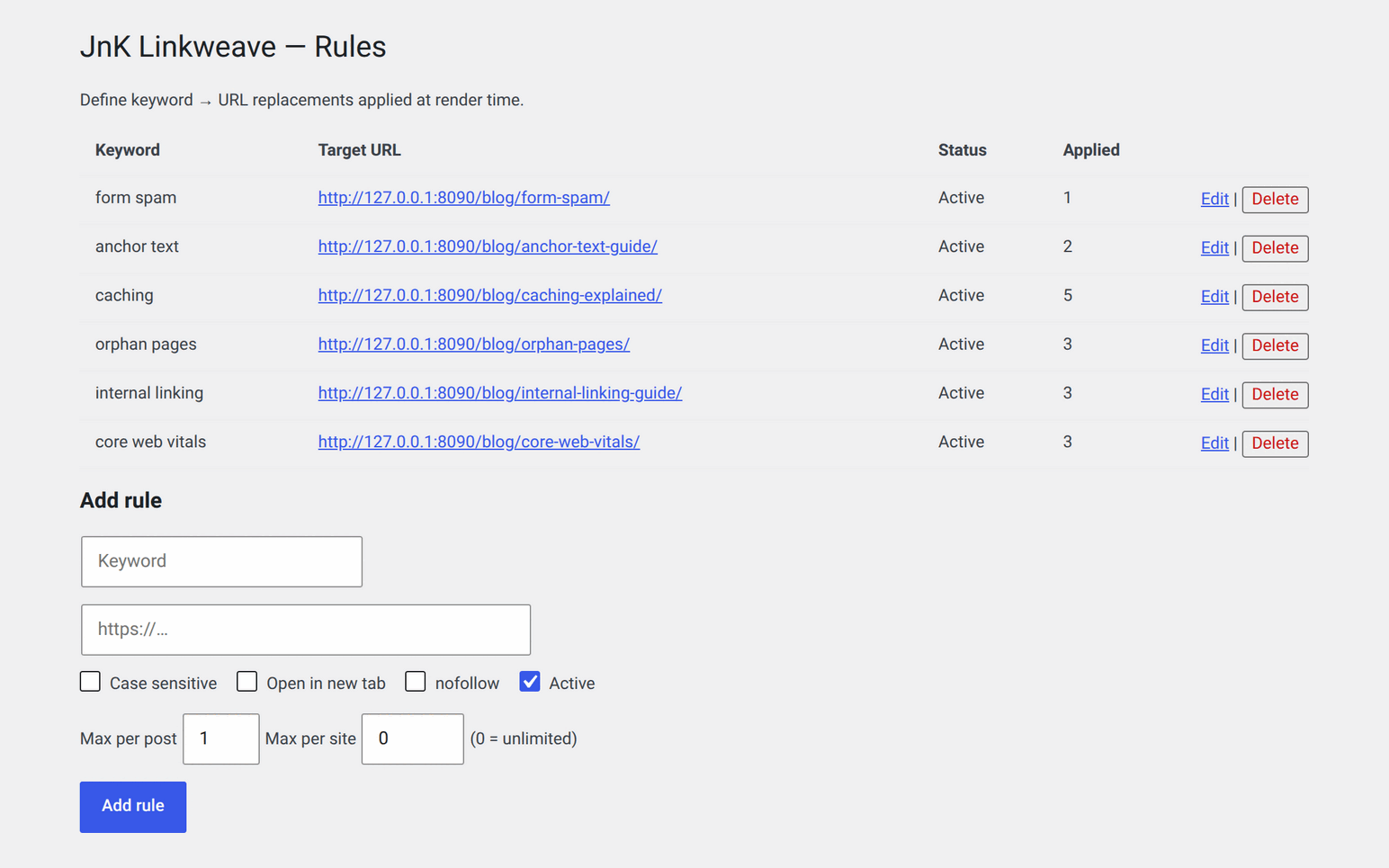
What you don’t get is a link-equity score. Linkweave reports counts, orphans, broken links and clicks, but it doesn’t estimate how authority is distributed. If that’s the number you manage by, Link Manager is the closer fit. Linkweave is also not in the WordPress.org directory right now (the listing is temporarily closed, pending a review), so it’s a direct download from us that updates itself from your dashboard.
4. Internal Link Juicer: set-and-forget keyword linking
Best for: people who mainly used the keyword rules and want them to run on their own.
Internal Link Juicer does one job well: you set target keywords per post, and it links matching phrases across the site, keeping an index that updates as content changes. Its anchor-variation options are more flexible than simple keyword rules, which helps avoid repeating the same anchor everywhere; see our guide to anchor text best practices for why that matters.
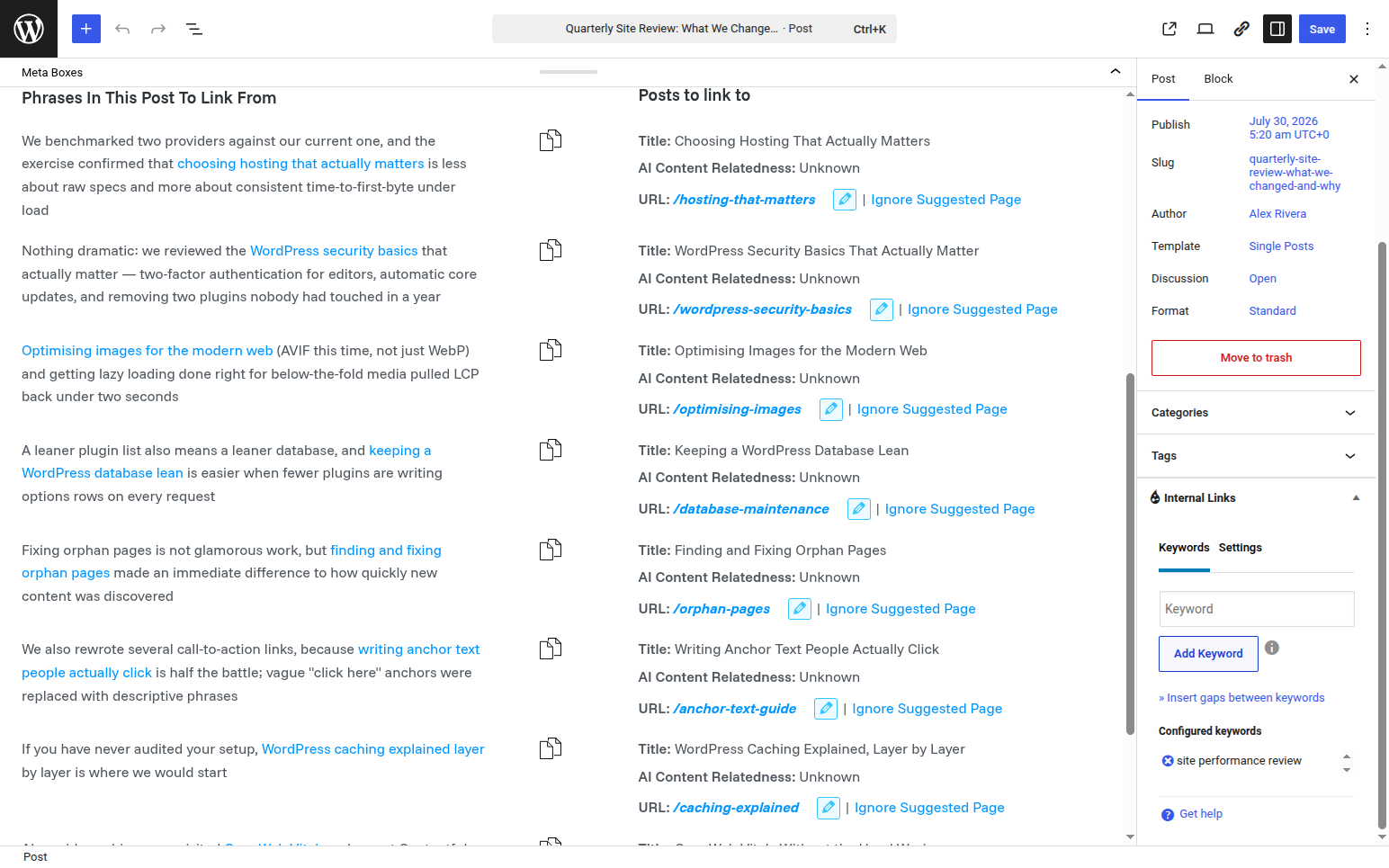
Pricing: the free version works on posts and pages for one site. Pro is a yearly licence at $69.99 for one site, $149.99 for five, $189.99 for ten and $1,299 for unlimited, and extends linking to terms and custom fields. It’s automation-first: no click tracking and no link-equity model.
5. Yoast SEO Premium: if you already pay for it
Best for: sites already on Yoast Premium that want suggestions without another plugin.
Yoast Premium is $118.80 a year (ex VAT) and one subscription covers one site. While you write, it suggests related content that you copy or drag into the text, and its orphaned-content finder lists posts with no links pointing at them. There are no automatic links, keyword rules or click tracking. Using it because you already own it is sensible; buying it just for linking is not good value.
6. Doing it by hand
Best for: small sites and anyone who wants full editorial control.
On a site with a few dozen posts, a simple habit works: each time you publish, find two or three related posts and link both ways. It costs nothing and every anchor is one a person chose. The limit is maintenance. Past a hundred or so posts you’ll collect orphaned pages and broken links you never notice, and nobody goes back to link old posts to new ones. That upkeep, not inserting links, is the best argument for a tool.
Side by side
The successor against ours, cell by cell, with a source behind each one. Link Manager’s columns come from its wordpress.org listing (which lists its own free-versus-Pro split) and daext.com, read 18 September 2026; we did not buy Pro, so anything those pages do not settle is marked rather than guessed. Ours are checked against the released Linkweave 1.7.0 builds.
✓ included✓ Pro+ only from that tier up~ partly (catch noted)✗ not availablenot tested hands-on paid screen we did not buy
Finding links to add5 rows
| Feature | Link Manager (free) | Link Manager Pro | Linkweave Free | Linkweave Pro |
|---|---|---|---|---|
| Suggestions inside the post editorLink Manager scores candidates by title overlap, shared categories, tags and post type; ours ranks with BM25 over the post text. | ✗ No | Scored by title, categories, tags | Gutenberg and Classic | + bulk insert and AI re-rank |
| Inserting a suggestion | ✗ No | Copy the URL to your clipboard | One click in the editor | + bulk-apply across posts |
| Posts that should link here (inbound) | Inbound counts in the dashboard | Inbound counts and equity | ✓ Yes | + bulk-apply |
| Search Console as a signal | ✗ No | ✗ No | ✗ No | GSC CSV import |
| Focus keyword boost (Yoast, Rank Math) | ✗ No | not tested hands-on | ✗ No | ✓ Yes |
Automatic linking4 rows
| Feature | Link Manager (free) | Link Manager Pro | Linkweave Free | Linkweave Pro |
|---|---|---|---|---|
| Keyword to URL auto-link rules | ✓ Yes | ✓ Yes | Unlimited, with per-post and per-site caps | Unlimited |
| Restrict a rule by post type, category or tag | ✓ Yes | ✓ Yes | Post types only | Post types only |
| Bulk-create rules from a spreadsheet | ✗ No | ✓ Yes | ✗ No | One-click cluster map instead |
| Related posts block | ✗ No | ✗ No | ✗ No | ✓ Yes |
Reports and repairs10 rows
| Feature | Link Manager (free) | Link Manager Pro | Linkweave Free | Linkweave Pro |
|---|---|---|---|---|
| Link equity estimate per URL | ✓ Yes | ✓ Yes | ✗ No | ✗ No |
| Optimization status against a recommended link count | ✓ Yes | ✓ Yes | ✗ No | ✗ No |
| Orphan page report | not tested hands-on | not tested hands-on | ✓ Yes | + CSV export |
| Broken internal links | ✗ No | HTTP status monitoring | Daily scan, read-only | + one-click unlink or replace |
| Click tracking | ✗ No | Every link, internal or external | ✗ No | Internal links |
| Domains report for outbound links | ✗ No | ✓ Yes | ✗ No | ✗ No |
| Anchor text report | ✗ No | not tested hands-on | ✗ No | Over-used anchors flagged, CSV |
| CSV export of the reports | ✗ No | ✓ Yes | ✗ No | ✓ Yes |
| Bulk URL changes with rollback | ✗ No | not tested hands-on | ✗ No | Per-batch rollback |
| Link between your own sites | ✗ No | ✗ No | ✗ No | ✓ Yes |
Operational3 rows
| Feature | Link Manager (free) | Link Manager Pro | Linkweave Free | Linkweave Pro |
|---|---|---|---|---|
| Role-based access to the plugin menus | ✗ No | ✓ Yes | ✗ No | ✗ No |
| Content stays on your server | ✓ Yes | ✓ Yes | ✓ Yes | Unless you turn on AI re-ranking |
| Active installs of the free build | 1,000+ (7,000+ on Interlinks Manager) | n/a | Direct download; our wp.org listing is closed pending a review | n/a |
Price and licence6 rows
| Feature | Link Manager (free) | Link Manager Pro | Linkweave Free | Linkweave Pro |
|---|---|---|---|---|
| Cheapest plan, yearly | $0 | 1 site: $59 | $0 | Solo, 3 sites: $29 |
| 5 to 10 sites, yearly | $0 | 5 sites: $99 | $0 | Studio, 10 sites: $49 |
| 25 sites or more, yearly | $0 | 25 sites: $149 | $0 | Agency, unlimited: $99 |
| Lifetime licence | n/a | ✗ No | n/a | From $89 once |
| Plugin keeps working after the licence expiresTheir FAQ: "The plugin is open source. Link Manager will continue working when your license expires, but you will no longer be able to download the latest plugin updates." | n/a | ✓ Yes | n/a | Inserted links stay; rule links stop |
| Refund window | n/a | 30 days | n/a | 14 days |
Sources (4)
- Link Manager: https://wordpress.org/plugins/daext-autolinks-manager/
- Link Manager: https://daext.com/link-manager/
- Link Manager: https://wordpress.org/plugins/daext-interlinks-manager/
- Linkweave: https://jnkplugins.com/jnk-linkweave/pricing.php
Only in Link Manager
- Link equity estimates and an optimization status per post, judged against a recommended link count.
- Click tracking on every link, internal or external, plus a domains report of everywhere you link out to.
- Rule targeting by category and tag, bulk rule creation from a spreadsheet, and role-based access to each menu.
Only in Linkweave
- Suggestions in the free build, inserted with one click rather than copied to your clipboard.
- Orphan and broken-link reports free, with one-click repair and a bulk URL changer with rollback in Pro.
- A lifetime licence from $89, and cross-site linking between sites you own.
So which one?
- You’re happy with Interlinks Manager and just want it supported: move to Link Manager.
- You manage by the link-equity number: Link Manager too. None of the others estimate it.
- You mainly used keyword auto-links: JnK Linkweave (free, unlimited rules) or Internal Link Juicer (free for one site, more anchor variation).
- You want the smoothest suggestion workflow and will pay for it: Link Whisper.
- You want click tracking: Link Whisper, Link Manager Pro or JnK Linkweave Pro all have it now.
- You already own Yoast Premium: try its suggestions before buying anything.
- Your site is small: do it by hand and revisit when upkeep slips.
Whichever way you lean, run a free version or use a refund window against your real content before committing. For the wider field, see our roundup of the best WordPress internal linking plugins.
Frequently asked questions
Is Interlinks Manager discontinued?
It has been superseded. DAEXT’s wordpress.org listing says Interlinks Manager has been replaced by Link Manager, will receive maintenance updates for compatibility and security until 8 July 2027, and will then be removed from the WordPress.org plugin directory. Checked 16 September 2026.
Is there a free alternative to Interlinks Manager?
Yes. Link Manager, its successor, has a free version with keyword auto-links, link stats and the link-equity calculator. JnK Linkweave’s free version includes unlimited auto-link rules, content-based suggestions, an orphan report and a broken link scan, and Internal Link Juicer’s free version handles keyword auto-linking on one site. Click tracking is a paid feature in all of them.
How much does Link Manager cost?
Link Manager Pro is $59 a year for one site, $99 for five sites and $149 for twenty-five sites, with a 30-day refund policy. The plugin keeps working if the licence expires, but updates stop. Prices checked on daext.com on 16 September 2026.
What does Interlinks Manager do better than its alternatives?
Its link-equity estimate, which scores how internal linking value is spread across your posts. Link Manager carries that forward; Link Whisper, JnK Linkweave, Internal Link Juicer and Yoast Premium don’t attempt it.